


Pizza ovens look deceptively simple. Dome goes on stand, fire goes in dome, pizza comes out. The showroom models sit on clean concrete slabs with nothing around them, so it’s easy to assume placement doesn’t matter much.
Then you get yours home and realise you’re dealing with 300 kilograms of stone and steel that pumps out heat and smoke, needs room to work, and can’t be easily moved once it’s in position. Get the location wrong and you’ll spend the next year fighting problems that were entirely preventable – smoke blowing into the house, not enough space to manoeuvre a peel, or a surface that’s cracking under the thermal load.
Here’s what actually matters when you’re working out where to put it.
Before you think about aesthetics or convenience, spend an evening in your backyard with a beer and pay attention to where the wind goes. Because that’s where your smoke will go, and no amount of carefully chosen pavers will fix a smoke problem.
Most Australian backyards have a prevailing wind direction. In Sydney it’s often from the east. In Melbourne it swings around more, but there’s usually a pattern if you watch for it. Your oven needs to be positioned so the breeze doesn’t blow smoke back at the opening or straight into your seating area.
If you’ve got a covered alfresco, this gets trickier. Smoke needs somewhere to go. A flue helps – it pulls the smoke up and away – but it won’t work miracles if you’ve boxed yourself into a corner with no ventilation.

You need at least a metre of clear space in front of the oven. When you’re launching a pizza on a long peel, or turning it with a smaller one, or pulling out a roast lamb that’s been in there for three hours, you need room to move without backing into furniture or garden beds.
Most people underestimate this. They see the oven dimensions – say, 60 centimetres wide – and think that’s all the space they need. Then they’re out there on a Saturday night doing an awkward shuffle with a scalding-hot cast iron pan, wondering why this feels harder than it should.
You also want working space beside the oven for prep – somewhere to rest the peel while you’re checking the base, or to set down your thermometer, or to stage the next round of pizzas. It doesn’t have to be fancy. A small stainless steel bench or even a heat-resistant trolley will do.
Pizza ovens are heavy. Even the smaller models weigh 70 kilograms. The bigger ones push 300. That’s a lot of weight concentrated on whatever you’ve put underneath.
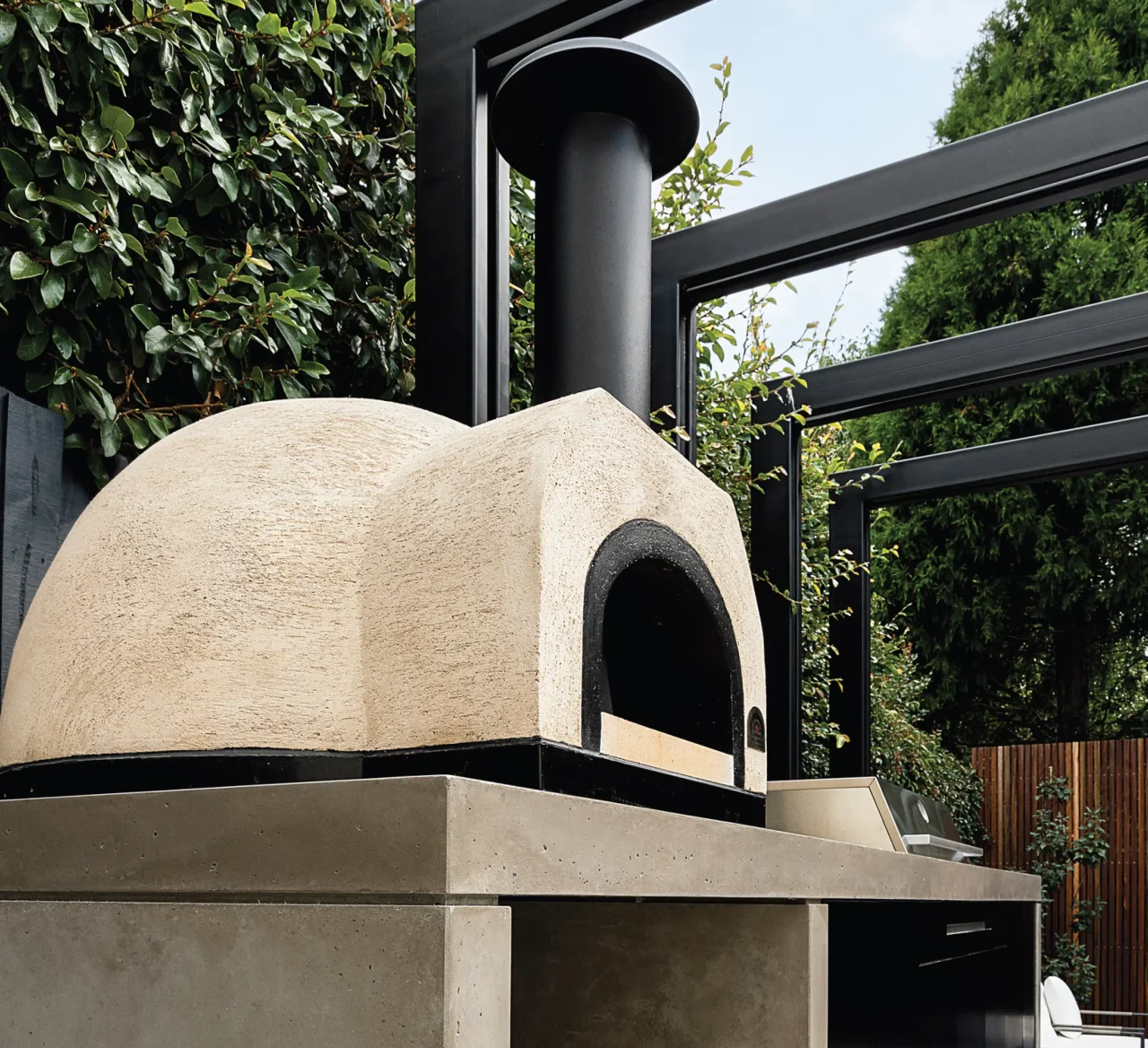
If you’re going straight onto pavers, make sure they’re on a proper compacted base, not just sand. The heat cycling – up to 400 degrees when the oven’s running, back to ambient overnight – will cause movement if the foundation isn’t stable. You’ll end up with cracks in the oven floor or, worse, a lean that affects how pizzas cook.
Concrete is better. A reinforced slab is best, especially for the heavier models. Some people use bluestone or granite, which handles heat well and looks good, but it needs to be thick enough to take the weight without cracking.
If you’re building a benchtop setup as part of an outdoor kitchen, get a professional to check your plans. Expensive installations can go wrong because someone assumed their brick structure could handle the load and it couldn’t.
Wood gives you flavour and theatre. It also gives you smoke, ash management, and the need to learn how fire actually behaves. If you like the ritual of it – splitting kindling, building a flame, watching the dome go white-hot – wood is worth the effort.
Gas is easier. Turn it on, wait twenty minutes, start cooking. The cleanup is minimal, and you’re not dependent on having dry wood . But you lose that smokiness, and for some people, that’s the whole point.
Hybrid ovens let you have both. Start with gas to get the temperature up quickly, switch to wood when you want the flavour. Or use gas for weeknight cooking and save the wood-fired experience for when you’ve got time to enjoy it.
The practical consideration is storage and access. Wood needs to be kept dry in a covered bay or shed near the oven. Gas needs a bottle, which means a clear path for changing it over and somewhere safe to store a spare. Hybrid means planning for both.


A good flue makes everything easier. It improves the draw, which means your fire burns hotter and more efficiently. It directs smoke up and away, which keeps your guests comfortable and your neighbours from complaining. All Jalando wood fired ovens come with a flue. It’s a flue extension or elbow bends you need to consider depending on you’re your set up.
Height matters with flues. Too short and it won’t pull properly. Too tall and it becomes a windbreak that creates turbulence. Most manufacturers will give you a recommended height based on the oven model and your typical setup.
This is where people get unstuck. They order a 250-kilogram oven, then realise their side gate is 85 centimetres wide and the crate is 90. Or they’ve got a steep slope between the driveway and the backyard. Or there’s a low-hanging veranda they didn’t account for.
Measure everything before you order. Width of gates, height of doorways, any steps or slopes, the turning radius if you’ve got tight corners. If you’re not confident moving that much weight safely, pay for delivery and installation. It’s not worth a back injury or a cracked oven to save a few hundred dollars.
If you’re picking it up yourself, you need a ute or trailer with a proper load rating, tie-downs that actually work, and someone to help you unload. Ovens are awkward as well as heavy – the weight distribution isn’t intuitive, and if you drop one, that’s the end of it.
Once the oven’s in place, you can’t just fire it up and start cooking. The stone needs to cure – a gradual process of heating and cooling that drives out moisture and prevents cracking.
This takes patience. Low fires for the first few burns, gradually increasing the temperature over several sessions. Rush it and you’ll hear cracks forming. Do it properly and the oven will perform better and last longer.
Jalando Pizza Ovens provides these instructions. Follow them. It’s tedious, but it’s also the difference between an oven that works well for years and one that develops problems within months.
Spend a week thinking about placement before you commit. Watch the wind. Measure twice. Build a proper base. And if you’re not sure, talk to someone who’s done it before – most owners are happy to share what they learned the hard way.
Once your oven is set up properly, a pizza oven changes how you use your backyard. It becomes the reason to have people over, the excuse to spend Saturday afternoon outside, the thing that makes winter evenings feel less bleak.
But that only works if you’ve thought through the practicalities first. Because no matter how good your dough recipe is, it won’t fix a badly positioned oven that fills your yard with smoke every time you light it.