


You’ve fired up your pizza oven, you have three or four paddles leaning against the wall, and you don’t know which one to grab first. Each pizza paddle has a specific job: launching, turning, and serving. Use the wrong one for the wrong job and you’ll end up with a torn pizza, a soggy base, or a burnt mess of semolina under the dough.
In the video, Julian from Campoli Foods walks through which paddle does what. His advice is clear and worth passing on.
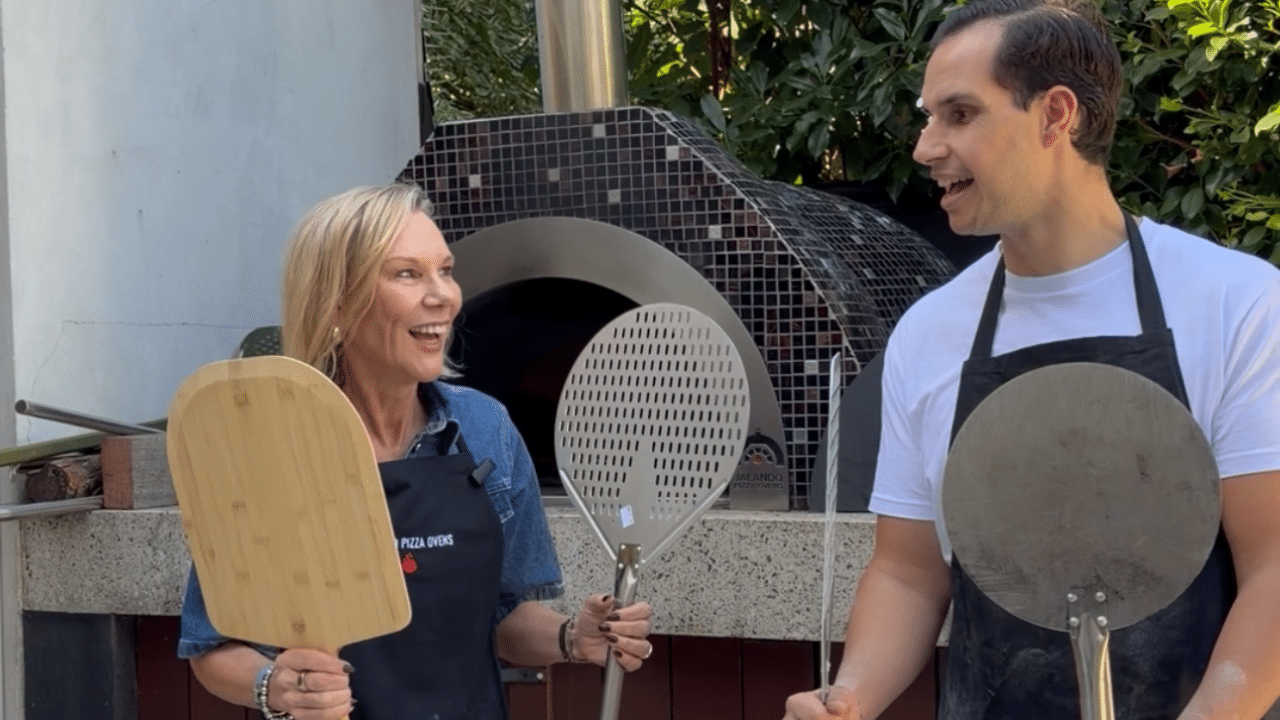
The launch is where most things go wrong, and the tool you use makes the difference.
A timber board works as a substitute. Wood doesn’t hold moisture the way metal does, so the semolina sits on the surface and the dough doesn’t stick. If you have a wooden serving board on hand and no perforated peel, use it.

The flat circle paddle, sometimes called a turning peel, is the right tool for rotating the pizza inside the oven. It’s also what you use to lift the base briefly and check the colour underneath.
Turning peels are not for launching. Launching peels are thicker, and the extra thickness means trying to slide one under a raw pizza will usually tear the dough. So use the turning peel inside the oven only.
A 90-second cook in a hot Jalando wood-fired oven needs at least one or two turns to colour the pizza evenly, which is why the turning peel earns its place in the kit despite having only one job.
Pull the cooked pizza out with the perforated peel and land it on a timber board for cutting. A standard dinner plate is too small to cut a pizza on cleanly. You’ll end up sawing toppings off the edge and onto the bench. A wooden serving board doubles as a launching board if you don’t have one of each, which makes it the single most versatile piece of kit in a pizza-oven setup.
A working three-tool kit is one timber launching and serving board, one perforated metal launching peel, and one flat circle turning paddle. If you only fire up the oven occasionally and stick to small pizzas, a board and a turning peel will see you through. For anyone running larger pizzas at full temperature on a regular basis, all three are the easier way to work. If you’re putting your kit together, the Jalando accessory range covers all three at the Preston showroom.
Match the paddle to the largest pizza you cook. A 30 cm pizza needs a paddle with at least a 30 cm working surface, plus a bit of edge for sliding the pizza off. Too small and the pizza overhangs and folds during the launch.
Two main reasons: the dough has been sitting on the peel too long, or you’ve used a solid peel where a perforated or wooden one would work better. Build the pizza fast, give the peel a small shake before launching to confirm the dough is loose, and add a sprinkle of semolina under any spot that has stuck.
Wipe it down with a damp cloth after each use and dry it straight away. Don’t put a wooden peel in the dishwasher and don’t soak it in water. Once or twice a year, rub a thin coat of food-safe mineral oil into the surface to stop the timber drying out and splitting.
A single timber board can cover the occasional pizza night. The compromise is that you’ll struggle to turn the pizza cleanly mid-cook, so you’ll need to pull the whole pizza out, rotate it on the board, and slide it back into the oven. Workable, but slower than working with a dedicated turning peel.
Suzanne is the owner of Jalando Pizza Ovens, which she founded in 2014 and named after her two sons James and Orlando. The Preston-based business supplies Australian-designed wood-fired, gas, hybrid, and DIY-kit ovens through a national retailer network and online. Jalando ovens featured on The Block 2024.
Julian, a trained chef and pizza chef, appears in the video on behalf of Campoli Foods, a Reservoir-based Italian ingredients wholesaler founded by the Ieraci family in 1952 and now in its third generation. The business supplies pizza shops, chains, and restaurants across Melbourne and regional Victoria, with a product range built around the needs of the pizza trade.